Wednesday, November 30, 2011

TSP Change Effective November 30th

.

All,

I’m updating my TSP allocation to the following:

G-Fund:  59%
F-Fund: 18%
C-Fund: 11%
S-Fund: 10%
I-Fund: 2%

If you make your changes by noon EDT they will be effective today.  If you wait a day, no issues in the big picture, except the exchange will count against the two you have available in December.

The rationale for the change today is partly based on numbers and partly based on seasonality.  The numbers part is due to a number of my short-term timers indicating that we have been oversold and that we need to participate in the present climate.  The move over the last few days has been quite weak though, and I expect more of the same, hence why 59% is in cash.

The seasonality component typically says that the period between Thanksgiving and Christmas has been up more than it has been down.  We have had no exposure to equities, hence the move into the C-Fund (11%), S-Fund (10%), and I-Fund (2%).  Our risk is quite controlled here and if this signal reverses (very possible), we'll move back into cash/bonds.

Regards,

pgd

Monday, October 17, 2011

Allocation Change for Monday, October 17

Effective immediately, I’m changing TSP allocations:

G-Fund:  94%
F-Fund:  6%

My short-term risk model has signaled overbought conditions and stalling, which is where we are not advancing yet we are exposed in terms of risk.  Even with the significant strength in the I-Fund and C-Funds, I’m anticipating a short-term pullback which will reveal itself to be either shallow (a buying opportunity) or worse-than-previous (“thank gosh we  moved to cash and bonds”).  I expect to be making another allocation change within the next few weeks, depending upon the anticipated pullback.  If we continue higher with no pullback, risk dominates from here and upside is quite limited compared to how far we can fall.

If you make the change prior to 12:00 EDT the change will be effective today.

As a reference point, since our allocation on 8/31/11, we are nearly EVEN on the market, specifically, down only -0.087%.  No gain in this time frame and some exposure is not a good situation, hence the need for the reallocation.  

In reality, for the period 8/31/11 to 10/14/11, the previous allocations have resulted in the following gains and (unrealized) drawdowns:

G-Fund:  +0.149% gain, no drawdown 
F-Fund:  -0.011% gain, -0.028% maximum drawdown
C-Fund: +0.041% gain, -0.545% MDD
S-Fund: -0.128% gain, -0.959% MDD
I-Fund: -0.138% gain, -0.727% MDD
Totals:  -0.087% gain, -1.927% MDD

For the past 12 month rolling period, we are up 6.94% with -3.325% realized drawdown (May 24th).  This is a 2:1 reward : risk ratio and is our minimum goal.

Cash is king, at least for the next week or two.

Regards,

pgd

Monday, September 5, 2011

Weekend Update for September 2nd

.
Changes to the account were made on August 31st in accordance with the previous post.  Since that time we've lost -0.574% in the account with the broader markets losing between -2.8% and -4.5%, but on a rolling-year basis we're up nearly +10.35%, so we're doing well.  The aggressive strategies that I use in my wife's TSP account showed that August was a good month for us, where we caught +2.9% gain with only about 1/3 exposure to the markets.  Note that over this time frame the S&P500 lost a bit more than 5% and drawdown was considerably more.

Looking forward to the next few weeks, your crystal ball is as good as mine.  This being said, the following document gives you some perspective on the market from an professional view.  Pay particular attention to the comments about the SPX falling through 1100 and ultimately testing as low as 1018, which will certainly cause me to move all our equity exposure to cash as soon as 1100 is penetrated.  Conversely, if 1100 is tested and holds, then I'll more than likely become more bullish and expose a bit more to the equity side of the markets.

To recap, we're 79% in the G-Fund (money markets), 12% in the F-Fund (bonds), 5% in the C-Fund (S&P500), 3% in the S-Fund (ex-S&P500), and 1% in the I-Fund (international).  I'm holding this allocation into the upcoming week.

=================

Remember, you are responsible for your own trading, and I am not.  Please do your diligence, and please take ownership for your actions.

Regards,

pgd


Wednesday, August 31, 2011

End-of-August Update/Tweak

.
I am updating this as we move into the last day of August.

Over the last week the rate-of-change indicators on the C-Fund (SPY), I-Fund (EFA), and S-Fund (VXF) have moved quickly -- too quickly in fact.  I am aggressively allocated as per my previous message here, and the gains since that change are +1.203% in 6 trading days.  Normally, I'd yawn at this, but considering that we're heavily in cash (G-fund, 67%), this is a notable movement and one that is too aggressive for the volatility of the markets right now.

My risk models are all suggesting that this leg upward is failing to materialize, and that we are due for a pullback. While my longer-termed outlook is still cloudy (your crystal ball is as good as mine), my short-termed one suggests a reallocation to lighten up on equity until we get a clearer emergence of a trend upward.

Again, this trend upward has moved far too fast to be sustained.  Given this, I'm moving my wife's funds around as follows:

G-Fund:  79%
F-Fund:  12%
C-Fund: 5%
S-Fund: 3%
I-Fund:  1%

I consider this quasi-aggressive/conservative.  If your time horizon is long (like mine -- about 9 years), then this is probably too conservative, but I feel better.  Conversely, if your time horizon is short (e.g., less than 1-2 years), then for the short-term future (next month or so), then this allocation is probably a little too aggressive in the present climate.  If you fall into the shorter-termed category, look to lighten up (0% in) the I-Fund and S-Fund and put these monies into the G-Fund as a temporary parking place.  Both the S-Fund (small cap stocks) and the I-Fund (international stocks) are getting the heck walloped out of them lately and have the highest volatility.  A 20% drop in the markets here with the allocations shown above would take 2% off the top, and we've fought hard for these gains over the past 8 months (over 7% on a rolling 12 month tally).

Recapping, if conservative, look to the following allocation:

G-Fund:  83%
F-Fund:  12%
C-Fund:  5%

================

Remember, you are responsible for your own investment decisions, and I am not.  Please do your diligence, and please take ownership for your actions.

We'll revisit the portfolio this weekend.

Regards,

pgd


Monday, August 22, 2011

August 21st Weekend Update

.
In a nut shell -- no changes unless you have some tolerance for risk.

==============

I am presently 54% in the G-Fund (the equivalent of a money market) and 46% in the F-Fund (the equivalent of a bond fund).  Since these allocations on June 6:

  • F-Fund increase 3.218%
  • G-Fund increase 0.511%
In the same time the equity funds have been slammed:
  • C-Fund (equivalent to S&P500):  -12.090%
  • I-Fund (equivalent to international index): -15.732%
  • S-Fund (equivalent to ex-S&P500):  -16.787%
The allocations above in the account have a net realized and unrealized gain of +1.756% over 54 days, with the drawdown never exceeding -0.173%.  Drawdown is what makes us nervous and will take us off course with our strategies, so I'm comfortable with the present allocations.

==================

Outlook:

We may see some pressure on bonds (F-Fund) if the market begins to rally from here.  We are forming the second "bounce" of a double dip this summer, and the right side of a "W" typically keeps on moving upward if conditions are correct.  We literally are at the bottom of the second dip, so there is nothing to do in terms of allocations unless you are aggressive in your tolerance for risk.  My preferred approach here is to wait until we get an "all clear" on the equity markets (C-Fund, I-Fund, S-Fund), and as of today they are all quite bearish and telling us to sit on the sidelines.

No one would fault you if you took the F-Fund down to low values in your allocation, effectively locking in your gains to date.

No one would fault you if you also moved some funds into the equities, although this is a risky proposition at this time and could easily backfire.  For those of you interested in representative allocations, here are some suggestions:
  • F-Fund (bonds):  14%
  • I-Fund (international): 6%
  • C-Fund (S&P500): 6%
  • S-Fund (ex-S&P500): 7%
  • G-Fund (money mkt): 66%
Because my time horizon is longer, I plan to make the allocation changes above, effective today.  If you have a shorter time horizon than myself, I would consider sitting pat for now.

===================

Remember, you are responsible for your own investment decisions, and I am not.  Please do your own diligence, and please take ownership for your actions.

Regards,

pgd

Sunday, August 7, 2011

August 7 Weekend Update

.
I'm presently 54% in G-Fund, which is the equivalent of a money-market cash fund, and the balance is in the F-Fund, which is a bond fund.  We made this move effective June 6, 2011.

Since June 6 the account has increased +1.105% using the allocation levels above.  The high point of +1.365% was achieved with the close of markets on 8/4, and the low point of -0.173% was achieved on 7/1.  Given recent markets, this allocation is allowing me to sleep quite well and not have to play with this portfolio at all.

For the rolling 12-month period ending 7/31 the account has returned +6.36%.  This value has been dropping  over the past several months due to the cash position, but I do not think it is dropping as fast as it would have if we were in equities (C-Fund, I-Fund, S-Fund).

In the same time the performance of the individual funds is as follows:

  • S&P500/C-Fund has returned +14.68% with a drawdown of -7.04%
  • F-Fund has returned +0.68% with a drawdown of -4.63%
  • I-Fund has returned +9.51% with a drawdown of -10.7%
  • S-Fund has returned +22.43% with a drawdown of -8.88%
For comparisons, a buy/hold with equal weight on 8/2/10 within the equity funds (C, I, S)  would have produced a return of +15.49% with a drawdown of -8.01%.

====================

While I am somewhat disappointed at the returns compared to the benchmarks above I am quite content with the recent performance.  My longer-termed models have been quite bearish and hence the move in June.

The C-Fund has fallen -11.28% in the last month.  The I-Fund has fallen the same amount.  The S-Fund has dropped -16.55%.  Standard & Poors downgraded the debt rating of the U.S. after the market close on Friday night, in order to give the pundits time to think about this over the weekend.

Now is not the time to be in equities.  Although I do like to buy 20% of the recommended position size in equities with every drop of 10%, I'm going to hold off on this rule for now.  Despite this, for those of you who are more aggressive, you could allocate as follows:

F-Fund:  59%
C-Fund:  4%
I-Fund:  4%
S-Fund:  1%
G-Fund:  32%

This could be a good allocation if you have a long-term horizon, as it will permit you to participate on the upside if we move upward from here.  Conversely, if the markets fall, your exposure to the general markets is limited, even if they drop 25% from here (25% of 4 is 1%, so the most at risk is ~ 3%).

If the markets continue to drop I will most likely move some funds into equities as we cross the -20% from the peak level.

========================

Remember, you are responsible for your own investment decisions, and I am not.  Please do your diligence and please take ownership for your actions.

Regards,

pgd


Friday, July 8, 2011

Friday, July 8th Update

.
I'm sure many of you are wondering if the TSP allocations are going to flip any time soon, as the markets are up substantially in the last week or so.

Before we get there, let's review a couple of key points:

1) we can only move 2x within a given month.
2) historically, summer rallies are suspect, and are quite often fickle, as they can change quickly.  This can quickly unravel any unrealized gains that we have attained.

With this backdrop, let's look at the relevant timers:


Right click on the image to open in a separate window or browser tab.

This first one is the GGT set of timers that I use on proxy ETFs.  Here:

AGG = F-Fund
EFA = I-Fund
SPY = C-Fund
VXF = S-Fund

This set of timers uses price and volume to move long, and only price to move to cash.

You can see that the recommendations of the GGT system point us towards:

AGG / F-Fund in CASH
EFA / I-Fund invested LONG
SPY / C-Fund in CASH
VXF / S-Fund invested LONG

Quite a mixed bag.  What is best is when these are confirming, e.g., AGG is CASH (as now) and the others are all LONG (SPY is the holdout).  We do NOT have confirmation of this bull leg according to this timing system.

=============

We can group the three equity trades into a basket to form an index.  When the 5d simple moving average crosses the 65d SMA from below, we have a general buy signal for the three equities.  When the 5d crosses the SMA from above, we have a general sell signal.

This method is confirmed by the slope of the 65d SMA -- when it is positive, we have confirmation.  When it is negative, we avoid long positions.

This method avoids volume considerations.

Here's the chart:


The top pane is the slope of the 65d simple moving average.  You can see that it is positive, which is bullish.  You can also see that it is trending SIDEWAYS, e.g., not moving up.  This is cautionary.

You can see in the next lower pane that the 5d crossed the 65d from below.  In general this is a good indication, and is confirmed with the slope of the 65d above.

Finally, we see that in the pricing pane that price has started to trade above the 65d MA.  While not on a upward trajectory, the repeated close above the 65d for the past 4 days is encouraging.

From this chart, we can conclude that we have a confirmed entry on the 3 equity positions:  I-Fund, S-Fund, and C-Fund.

====================

Before we get all excited, I think it's important to understand the money flow into each of these ETFs.  Note that this is for the ETFs, NOT the individual funds (C-Fund, I-Fund, F-Fund, S-Fund).  The importance here is that the market plays these ETFs just like we are playing the TSP funds, so it's a reasonable proxy to be able to look at each of these ETFs in terms of money flow.

You can do this work yourself by joining the Effective Volume group at http://forums.effectivevolume.com

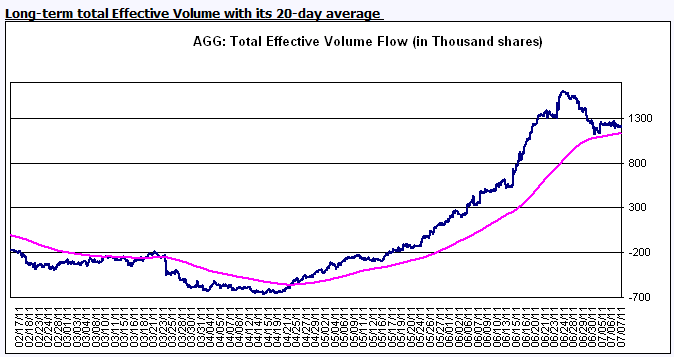
Here's AGG / F-Fund:


You're looking at what the large players are doing with AGG, which is a bond fund.  The blue trace is total effective volume (TEV), and the purple trace is a 20d moving average.

I look for the 20d MA to be pointing upward for a confirmation that I should be in the equity.  As you can see, AGG is still attracting money, but is doing it less fast than a few weeks ago.  If the TEV line crosses below the 20d MA then institutional support for AGG is declining, which is a bigger problem.   In general, I would not abandon AGG / F-Fund, simply because the 20d TEV line is still pointing upwards.

Next is the EFA / I-Fund:


Here, you can see that the 20d TEV line is in a strong uptrend, and that daily TEV continues to pull this line upward rather aggressively.  EFA / I-Fund appears to have significant institutional support, although you can see that over the past few months it has been very, very choppy.  This is somewhat problematic for our time horizon, but nevertheless, right now EFA appears to have the required sponsorship.

Next is the SPY / C-Fund:


The SPY is one of the most liquid (traded) ETFs on the market, so the TEV values above are quite relevant.  You can see that the 20d TEV levels are in a significant uptrend, and appears very strong.  Institutional support for the SPY is very strong.

Finally, the VXF / S-Fund is the last ETF to consider:


The presentation changed because the Effective Volume site does not track VXF, which is not nearly as liquid as the other ETFs.

The yellow and blue traces above are the relevant TEV and Large EV traces for VXF respectively, over the past week or so.  The nearly-horizontal red trace shows that Small EV folks (you and I) are not moving aggressively into VXF as an instrument.  The positive divergence of the TEV for VXF does point to significant institutional support, so I am encouraged.

Conclusion:  EFA has choppy TEV patterns, which means institutional support is mixed and fickle.  AGG, SPY, and VXF all look relatively good in terms of institutional support.

=====================

Given these conditions, the last decision is whether to jump in today, Friday, or wait for a pullback.

I prefer to wait for a pullback.  As long as the TEV 20d lines remain in an uptrend, we're relatively safe.  As long as the TEV continues to trade above the 20d lines, we have institutional support.  The overall problem is that the markets are heavily overbought, and there has not been a good opportunity to get into this rally except just to plunge in.  I do not "plunge", so I'm going to wait for the inevitable pullback.

For those of you who are aggressive, you can go with the following allocations:

AGG / F-Fund:  6%
EFA / I-Fund:  10%
SPY / C-Fund:  38%
VXF / S-Fund:  46%

This allocation will take advantage of the recent momentum but understand, it is a very aggressive stance.

=========================

The maximum gain/minimum volatility play is 100% in the VXF / S-Fund.  It is not unreasonable to expect an incredible amount of volatility here (~ 17%), but of the 4 funds, this has the largest potential gains going forward.

========================

The minimum volatility play, if you are not convinced in this market action, is as follows:

AGG / F-Fund:  87%
EFA / I-Fund:  2%
SPY / C-Fund:  10%
VXF / S-Fund:  1%

If we see a pullback I expect that AGG will perform quite well, relative to the other securities.  Conversely, if we continue upwards, this portfolio mix will significantly underperform the markets.

=====================

Uncertain times.  You'll have to choose the portfolio mixture that is aligned with your tolerance for drawdown and volatility.

I personally am going to wait for a pullback in the markets before changing my allocation, which is heavily weighted in the F-Fund.

====================